
Rendina logo

Rendina recognized as one of the Best Places to Work in Healthcare in 2019

Rendina Healthcare Real Estate, a national leader in healthcare real estate development, announced today that it has been selected by Modern Healthcare as a 2019 Best Place to Work in Healthcare. This award, which recognizes outstanding employers in the healthcare industry nationwide, is based on an assessment process that includes comprehensive employee surveys conducted in partnership with the Best Companies Group.


Rendina Healthcare Real Estate ensures its employees can achieve their full potential through ongoing education and training designed to advance skills and leadership abilities. Rendina also promotes team-building through opportunities to connect outside the office, including numerous events that feature activities ranging from deep-sea fishing and bowling, to volunteering at one of the many charities supported by its employees and the company’s Rendina Cares initiative.

“Despite the political headwinds that the industry faces, healthcare organizations continue to be dominant economic engines in their communities,” commented Aurora Aguilar, editor of Modern Healthcare. “Organizations recognized on this year’s list have also weathered mergers and reorganizations and have come out stronger. As evidenced every month by the Bureau of Labor Statistics employment numbers, the industry shows little sign of slowing down when it comes to creating jobs. And that puts pressure on employers to create not only robust compensation and benefit packages, but to create a sense of loyalty in competitive labor market. We congratulate the Best Places to Work in Healthcare for going above and beyond to create fulfilling environments for the nation’s professional caregivers.”

The complete list of this year’s winners, in alphabetical order, is available here. Modern Healthcare will publish a special supplement featuring ranked lists of all the winners along with the September 30 issue.

Rendina Healthcare Real Estate will be honored at the 2019 Best Places to Work in Healthcare awards gala on Thursday, September 26, 2019 at the Renaissance Dallas.
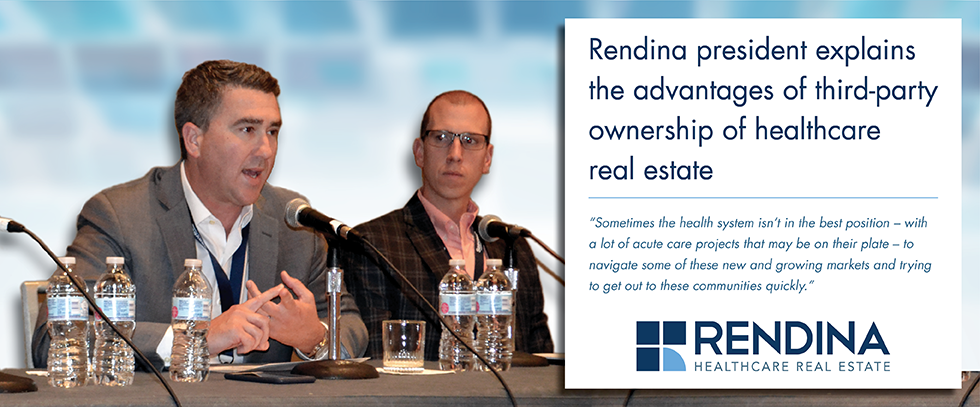

Rendina President Explains the Advantages of Third-Party Ownership of Healthcare Real Estate

Steve Barry tells BOMA MOB conference crowd that working with a real estate partner can provide many advantages in terms of capital, compliance, real estate expertise, speed-to-market and more

There can certainly be valid reasons for hospitals and health systems to own their own medical office buildings (MOBs) and other outpatient real estate. But financial and competitive pressures, as well as the growing sophistication of the real estate and healthcare industries, make third-party development and ownership an increasingly viable option.

That’s according to Rendina President Steve Barry, who spoke May 2 at the 2019 Building Owners and Managers Association (BOMA) International Medical Office Buildings + Healthcare Real Estate Conference in Minneapolis.

Mr. Barry was part of a panel discussion titled, “Keeping Up with the Joneses: Maintaining and Managing Your Asset Base.” Other participants in the session included Steven Chyung, SVP Supply Chain and Real Estate, SCL Health; Lee Nester, Director of Real Estate and Asset Management, CaroMont Health; and the moderator, Kyle Arnold, Director, Real Estate, CBRE Inc.

Whether a health system is better served by leasing or owning its medical office space depends on the specific system and project location, Mr. Barry told the capacity crowd at the Minneapolis Hilton. But working with a third-party developer is often preferable if a system needs speed-to-market or if it has other capital needs.


He continued, “Sometimes it makes sense to partner with a third party – even if you’re not leasing the property. Sometimes it’s a joint venture with a third party. The health system realizes they don’t have to own 100 percent of everything to be effective at what they’re doing.”

As a developer, Mr. Barry said, he has the opportunity to see firsthand how a wide range of health systems approach the “lease vs. own” decision, and it has been his experience that “the philosophy of the system leadership and the financial strength of that system really drives that decision from the top down in many cases.”

Sometimes it makes sense to partner with a third party – even if you’re not leasing the property. Sometimes it’s a joint venture with a third party. The health system realizes they don’t have to own 100 percent of everything to be effective at what they’re doing.

But Mr. Barry noted that in some other industry sectors, such as technology, investors often “punish” companies that own real estate because it is viewed as a drag on earnings. So with the growing financial sophistication of both investors and the healthcare industry, he said, “I think it’s a matter a time before certain health systems start to gravitate more toward that model and start to look at the operational upside in their business rather than just trying to own all the real estate.”

Third-party developers can also help with more than just capital, Mr. Barry added. As ambulatory strategies and consumer demand for convenience continue to grow in importance, healthcare real estate firms can bring valuable tools and expertise in helping systems to identify optimal locations for their MOBs and other outpatient facilities. Working with third-party developers can also help health systems to mitigate the risk of rising construction costs, he said.

The argument is similar for decisions about monetizing existing MOBs, Mr. Barry noted.

“I think a lot of health systems are facing the issue of aging infrastructure and how do you try to maintain those facilities – and is it the best use of their capital?” he said. Older MOBs often suffer from deferred maintenance issues, he noted, and “all these different buckets of cost that really start to add up, and a hospital looks at that and they ask, ‘Is this the best use of our capital, or should we look to monetize?’ ”

In addition, selling their MOBs to third-party investors enables health systems to avoid the potential “compliance headache” they might face if they are leasing space to affiliated physicians, Mr. Barry said.